



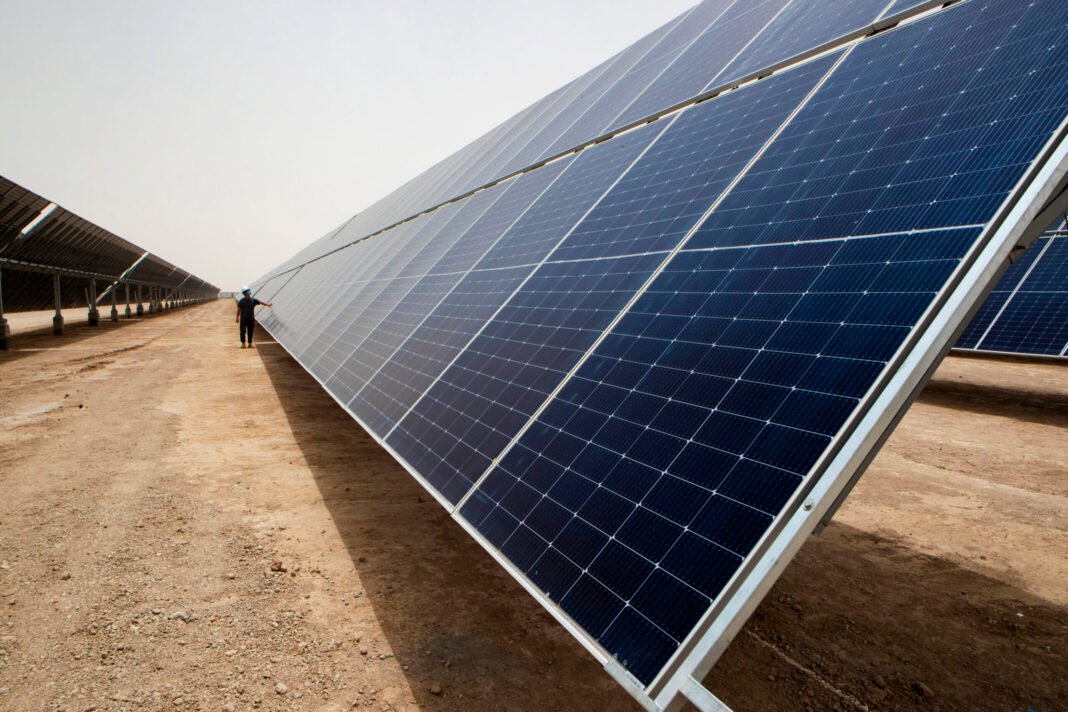
Iraq is accelerating its renewable-energy plans, raising the question of whether Iraq’s solar energy projects can ease the country’s oil dependence.
Caretaker Prime Minister Mohammed Shia al-Sudani recently instructed ministries and local officials to secure land for medium-capacity solar plants around Baghdad. These projects aim to begin operations before summer 2026.
The initiative forms part of a wider national plan to add around 12 gigawatts of solar capacity by 2030. Officials estimate this could meet one-fifth of Iraq’s projected electricity demand by the decade’s end.
Despite being a major oil producer, Iraq faces persistent electricity shortages, particularly during summer months when demand reaches 50,000–55,000 megawatts. Available generation currently covers just 27,000–28,000 megawatts. Consequently, households and businesses rely heavily on private diesel generators, which are costly and environmentally damaging.
Energy experts note Iraq’s dependence on Iranian gas is a key obstacle. Tehran supplies roughly one-third of the national output, covering 40% of gas needs. Supply interruptions and payment delays linked to sanctions exacerbate the country’s electricity challenges.
Economist Abbas al-Shatari explained that major power plants in Iraq are designed for high gas volumes. He highlighted the importance of securing at least 7,000 megawatts of additional reliable capacity to stabilize the grid.
Baghdad is now a pilot region for renewable-energy initiatives. Officials reviewed multiple proposals, including a 750-megawatt solar network on the city’s outskirts. They also discussed connecting the plants to the grid, arranging billing, and streamlining approvals to accelerate construction.
Energy expert Dr. Kovend Sherwani emphasized that solar projects can supply roughly a quarter of Iraq’s current shortfall over six to seven years. He added that falling technology costs allow at least one major solar plant per year.
Several projects are already underway outside the capital. The Ministry of Electricity has contracts for plants totaling 1,750 megawatts in Karbala, Muthanna, and Basra, involving international developers like Masdar, TotalEnergies, and PowerChina. In Basra, a 1,000-megawatt solar facility at Artawi oil field is in development.
Electricity Minister Ziyad Ali Fadel confirmed plans to add 10,000 megawatts of renewable capacity by 2030, supported by $6 billion in public and private investment. Meanwhile, the Central Bank of Iraq offers low-interest loans to households for rooftop solar installations through the Ministry’s “Ur” platform.
Specialists agree that solar power will not replace oil in Iraq in the short term. However, Iraq solar energy initiatives can reduce domestic oil use, improve exports, and lower dependence on Iranian gas.
The benefits extend regionally, as Gulf neighbors expand solar capacity and climate finance. Partnerships with international firms connect Iraq’s projects to broader technology and financing networks.
Iraq solar energy efforts are poised to reshape the country’s energy mix, increase sustainability, and strengthen its position in regional energy markets.