



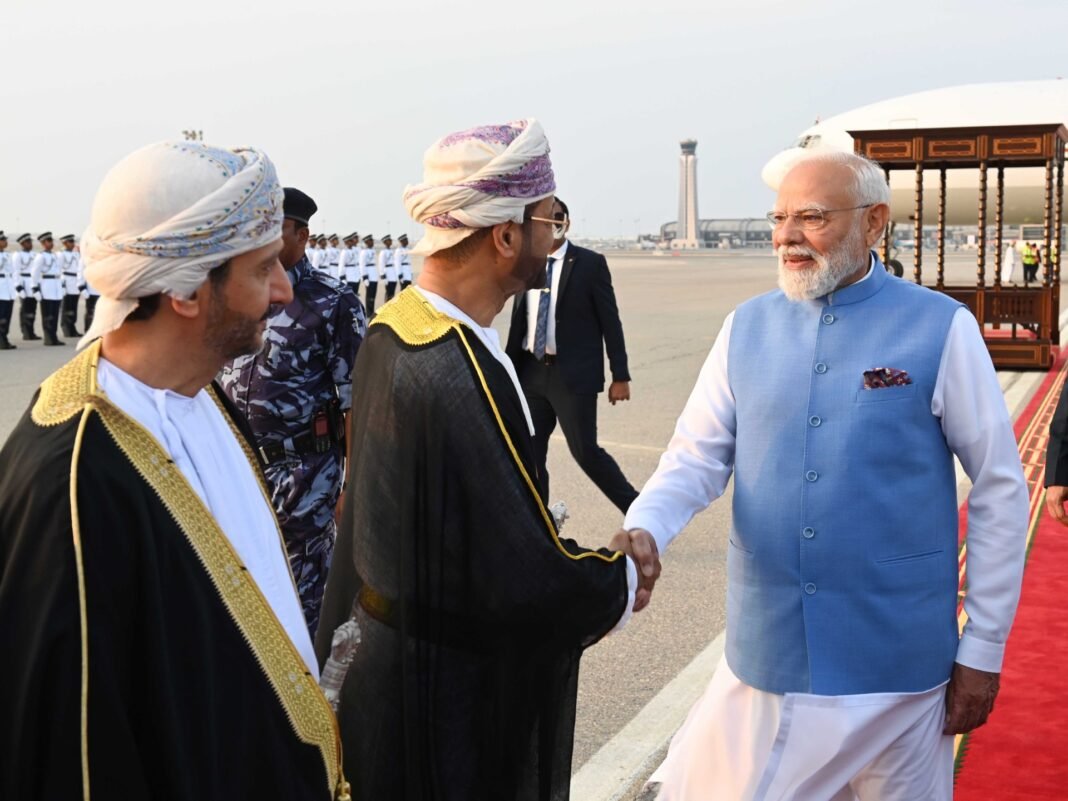
India and Oman have signed a landmark Comprehensive Economic Partnership Agreement (CEPA), creating new opportunities for trade, services, and professional mobility. The India-Omani CEPA strengthens bilateral economic ties and expands India’s engagement in the Gulf region.
The agreement was signed by India’s Union Minister for Commerce and Industry Piyush Goyal and Oman’s Minister of Commerce, Industry & Investment Promotion Qais bin Mohammed Al Yousef. Furthermore, it reflects the shared commitment of both countries to deepen economic integration.
Piyush Goyal highlighted that the India Oman CEPA provides near-universal duty-free access for Indian goods. Additionally, it promotes services opportunities, enhances professional mobility, and supports inclusive growth while safeguarding national interests. The agreement also introduces Oman’s first-ever commitment on Traditional Medicine, creating new prospects for India’s AYUSH and wellness ecosystem.
Bilateral trade between the two nations currently exceeds USD 10 billion, with strong potential for expansion under the CEPA framework. Moreover, India’s exports to Oman now benefit from zero-duty access on 98.08 percent of Oman’s tariff lines, covering 99.38 percent of Indian shipments. Meanwhile, India will liberalize tariffs on 77.79 percent of its tariff lines, covering 94.81 percent of imports from Oman.
Major sectors benefiting from the India Oman CEPA include gems and jewellery, textiles, leather, footwear, sports goods, plastics, furniture, agricultural products, engineering goods, pharmaceuticals, medical devices, and automobiles. Sensitive items like dairy, tea, coffee, and precious metals remain protected under exclusion lists.
The services sector gains significant advantages, as Oman imports USD 12.52 billion in services globally, yet India currently accounts for only 5.31 percent. The CEPA expands opportunities in computer services, business and professional services, audiovisual services, research and development, education, and healthcare.
A key highlight is enhanced professional mobility. Oman has increased the quota for intra-corporate transferees from 20 percent to 50 percent. It also extends permitted stays for contractual service suppliers from 90 days to two years, with a possible two-year extension. Skilled professionals in accountancy, taxation, architecture, and medical services will also benefit from liberalized entry and stay conditions.
The agreement allows 100 percent foreign direct investment by Indian companies in key services sectors through commercial presence. Additionally, both countries plan future discussions on social security coordination after Oman implements a contributory system.
Notably, the India-Omani CEPA is Oman’s first bilateral trade pact since its 2006 agreement with the United States. Overall, the deal positions India and Oman for stronger economic cooperation, trade growth, and long-term partnership in the Gulf region.