



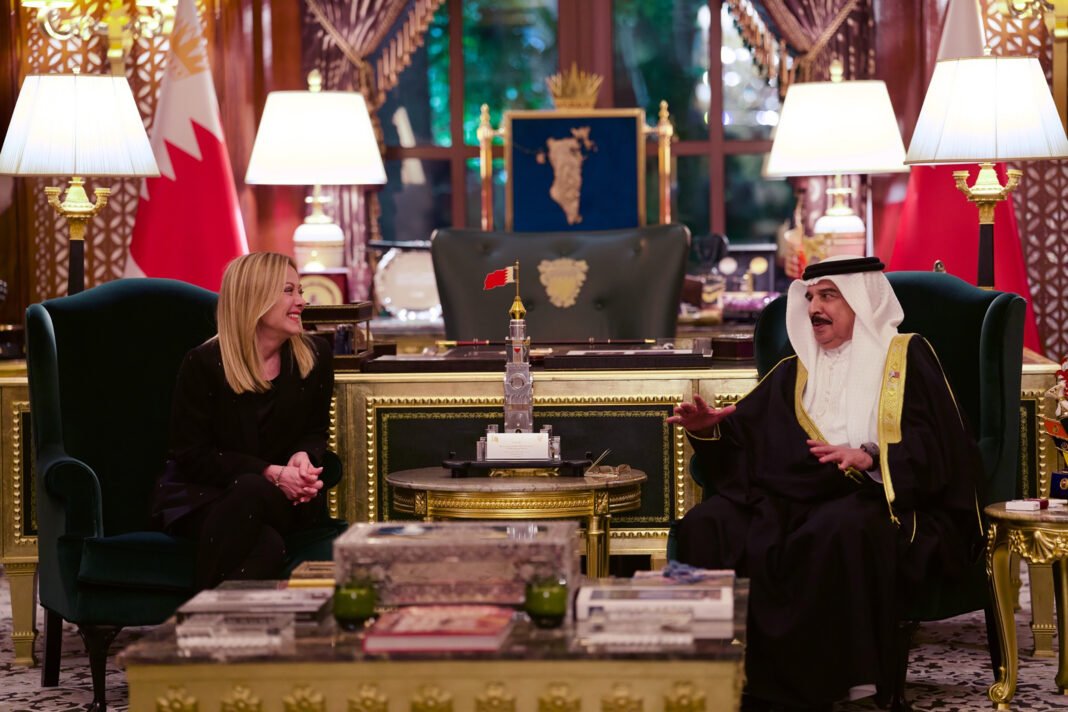
Italy has reinforced its Gulf strategy as Prime Minister Giorgia Meloni expanded high-level diplomacy and industrial cooperation across the region. The initiative reflects Rome’s focus on continuity, long-term partnerships, and structured engagement.
From Bahrain to Oman and Kuwait, Meloni shifted Italy’s approach from occasional visits and tactical agreements to leader-to-leader dialogue and strategic projects. Observers note this approach positions Italy as a credible and stable partner in both the Gulf and the Mediterranean.
In Bahrain, Meloni met King Hamad and Crown Prince/Prime Minister Salman Al Khalifa. During the discussions, they reaffirmed the Strategic Investment Partnership signed in September. They also explored regional stabilization, Middle East peace, and a just resolution in Ukraine.
The meetings led to two memoranda of understanding. First, Fincantieri and ASRY will co-design and co-produce military and offshore vessels, manage maintenance, and enable export cooperation through the Maestral joint venture. Second, Roboze and ASRY will implement a roadmap for a 3D-printing smart factory to localize component production.
Italy also highlighted Oman’s balanced foreign policy. Talks with Sultan Haitham covered Gaza, Yemen, Red Sea security, and Iran nuclear mediation. Rome praised Oman’s diplomacy and emphasized growing Italian corporate interest in Muscat’s development projects.
In Kuwait, Meloni met Emir Meshal Al Ahmad Al Sabah to strengthen defense cooperation and economic collaboration. They discussed investment returns from Kuwaiti projects in Italy and aligned on regional security and Middle East peace initiatives.
Additionally, Italy proposed hosting a strategic Gulf-Mediterranean Summit. The summit aims to enhance regional cooperation, strengthen economic links, and establish structured mechanisms for long-term stability without competing with existing forums.
Meloni also highlighted the India–Middle East–Europe Corridor as a transformative connectivity route linking India, Gulf ports, Europe, and the U.S. Italy promotes energy diplomacy under the Mattei Plan, emphasizing technological neutrality to support the energy transition.
On Middle East peace, Italy supports the U.S. initiative, reaffirms a two-state solution, and contributes through Palestinian security training and targeted aid. Rome also expressed readiness to facilitate renewed talks on Iran’s nuclear program.
Italy positions itself as a Mediterranean connector, drawing on historical trade routes and centuries of exchanges with the Arabian Peninsula. Meloni described the Mediterranean as the “heart of global exchanges,” underlining Italy’s forward-looking role in dialogue, stability, and regional cooperation.
Overall, Italy’s Gulf strategy now centers on structured diplomacy, industrial agreements, and long-term regional engagement. This approach cements Rome’s role as a strategic and reliable Gulf partner.

