



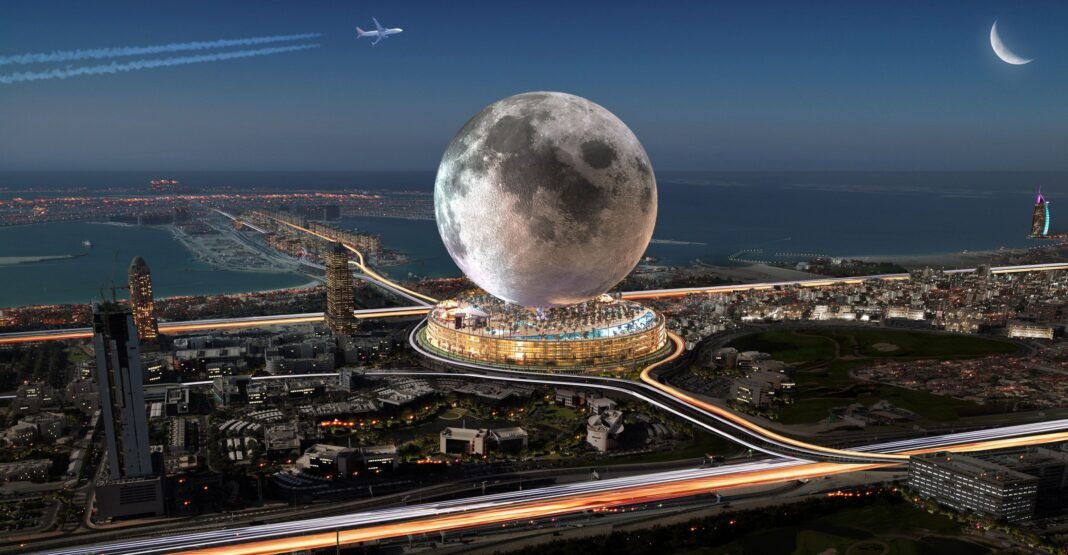
Moon megaproject expansion is moving from concept to execution as developers advance plans across ten countries. The ambitious initiative aims to reshape global tourism with a giant lunar themed resort concept that will attract millions of visitors annually.
A massive spherical structure rising more than 300 meters anchors the development. Designers plan to construct the world’s largest true sphere and position it as the resort’s main attraction. Inside, guests will experience a fully immersive lunar simulation that replicates the terrain and atmosphere of the Moon.
Moon World Resorts Inc. leads the strategy behind the project. Co founder Michael R. Henderson says global interest continues to accelerate, noting that hundreds of professionals apply to join the company each week. Investors and government officials are also increasing their inquiries as discussions expand across multiple regions.
Developers have identified ten potential host countries for the Moon megaproject expansion: United Arab Emirates, China, Thailand, Brazil, Poland, Spain, India, Australia, Egypt, and United States. Regional partners will own and operate each project while licensing the design and intellectual property from the parent company.
The central resort alone could require an investment of approximately $5 billion, excluding land acquisition. Despite the significant capital requirements, Henderson expresses confidence in private funding. He argues that investors seek stable, asset backed real estate projects that can generate long term returns.
However, government backing remains the critical first step. Authorities must grant fast tracked approvals and allocate land before financiers commit capital. Once governments confirm their support, financiers can move quickly. Markets such as China and the UAE can advance more rapidly because streamlined development processes support large scale construction.
The full masterplan spans roughly 500 acres. The sphere will house a 4,000 room luxury hotel that connects directly to the lunar environment experience. Developers expect the attraction to draw up to 2.5 million visitors annually.
Beyond the sphere, the complex will include convention centers, wellness hubs, retail districts, and entertainment venues. Residential components form a major pillar of the strategy, and developers plan to build approximately 10,000 upscale housing units. Designers also plan skywalks, green parks, and waterfront promenades to create a fully integrated live work play destination.
Developers could open the first Moon megaproject expansion location by 2032, and they may announce the final site as early as next year. If the team completes the project as planned, it will rank among the most ambitious tourism ventures ever attempted, blending hospitality, entertainment, and space inspired architecture into a global brand experience.