



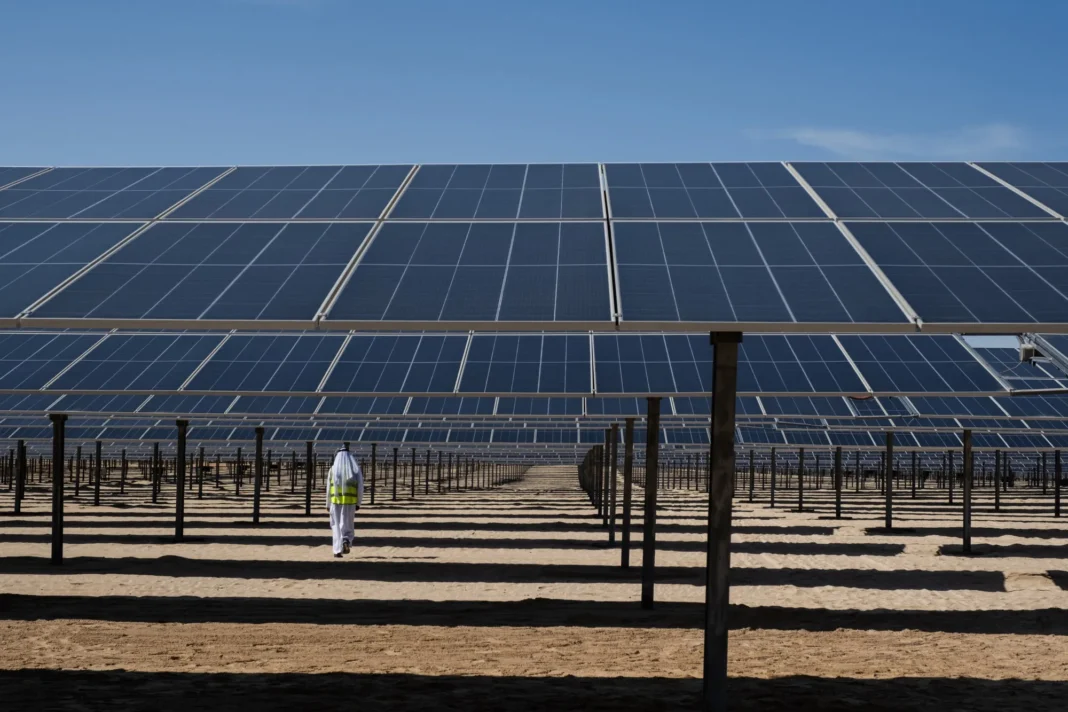
The UAE green bond deal has strengthened clean energy financing through a major refinancing move in Abu Dhabi. The transaction supports long-term renewable infrastructure growth. Moreover, it reinforces investor confidence in sustainable energy assets.
A consortium behind the Al Dhafra solar project completed a significant green bond issuance. The group raised USD 870.8 million through the transaction. As a result, the consortium refinanced the project’s existing debt structure.
The Al Dhafra facility delivers a total capacity of two gigawatts. Therefore, it ranks among the world’s largest single-site solar power plants. Additionally, the project supports Abu Dhabi’s clean energy transition strategy.
Several major companies participated in the bond issuance. These included Abu Dhabi National Energy Company, known as TAQA. Furthermore, Emirates Water and Electricity Company also played a central role.
Masdar joined the consortium as a key renewable energy partner. Meanwhile, EDF power solutions and Jinko Power Technology completed the ownership group. Together, the partners structured the refinancing through long-term green bonds.
TAQA holds the largest stake in the project. Specifically, the company owns forty percent of the solar park. In comparison, Masdar controls twenty percent of the ownership structure.
EDF and Jinko Power each hold equal stakes. Consequently, they share the remaining forty percent ownership. This balance ensures diversified international participation.
The green bonds carry a fixed annual coupon rate. The rate stands at 5.794 percent. Additionally, the bonds mature in June 2053, offering long-term stability.
Several international banks coordinated the bond sale. BNP Paribas and HSBC led the transaction process. Moreover, multiple global institutions supported the issuance as joint managers.
Credit Agricole CIB joined the syndicate as a lead manager. Likewise, MUFG, Standard Chartered Bank, and SMBC participated. Therefore, the deal attracted strong international banking support.
The Al Dhafra solar complex began commercial operations in mid-2023. Since then, it has delivered consistent power generation. Importantly, the facility supports national energy reliability.
The project site sits approximately thirty-five kilometers from Abu Dhabi city. As a result, it connects efficiently to the emirate’s grid infrastructure. The location supports large-scale energy distribution.
The solar park uses around four million bifacial solar panels. Consequently, it maximizes electricity output throughout the year. This technology improves efficiency under desert conditions.
The plant produces enough electricity for roughly two hundred thousand homes annually. Therefore, it significantly reduces carbon emissions. Additionally, it supports long-term sustainability goals.
Electricity output flows directly to Emirates Water and Electricity Company. The supply follows a long-term power purchase agreement. This agreement was signed in 2020.
Furthermore, the refinancing strengthens the project’s financial resilience. It also aligns with global green finance standards. As a result, the project attracts environmentally focused investors.
Industry analysts view the deal as a positive signal. Therefore, renewable energy financing continues to gain momentum in the UAE. This trend supports future clean energy investments.
Looking ahead, similar green bond structures may finance upcoming projects. Consequently, Abu Dhabi could expand renewable capacity further. Sustainable finance remains a key growth driver.