



Renewable Jobs remain a critical focus as global clean energy installations hit record highs, yet employment growth grows slowly. Furthermore, geopolitical tensions, automation, and uneven industrial capacity limit workforce expansion. Therefore, experts emphasize that governments must adopt stronger policies to ensure all regions benefit from the clean energy transition.
The report shows global renewable employment reached 16.6 million in 2024, increasing only 2.3 percent from 2023. Meanwhile, China continues to dominate the sector, creating 7.3 million jobs, or 44 percent of the worldwide total. In contrast, the European Union maintained 1.8 million jobs, Brazil accounted for 1.4 million, and the United States and India grew modestly to 1.1 million and 1.3 million jobs respectively. These figures highlight uneven development and stress the need for targeted industrial and workforce policies.
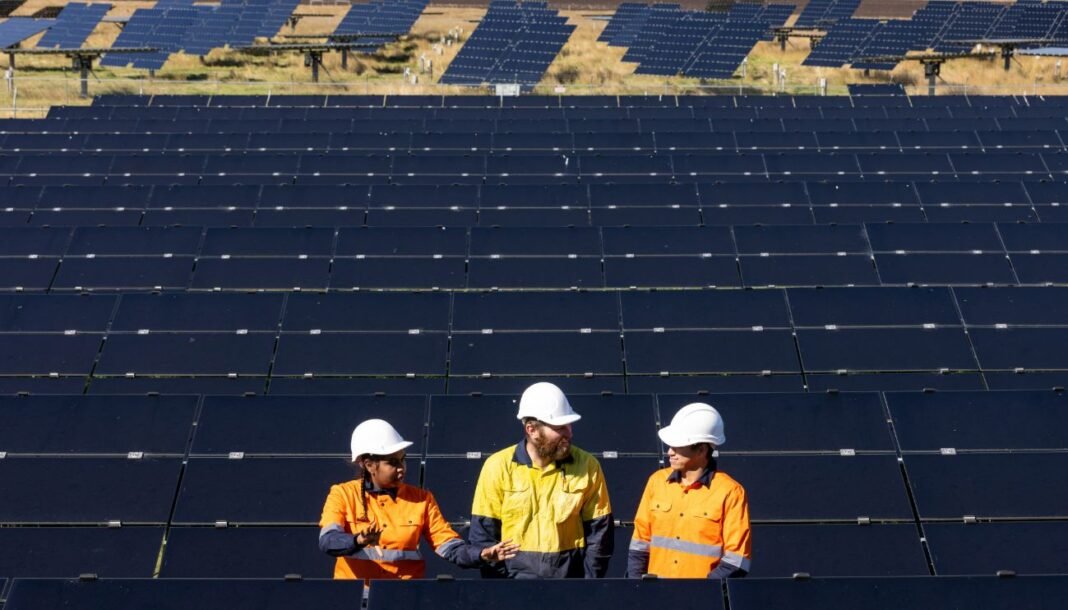
Solar photovoltaics leads employment among renewable technologies with 7.3 million workers globally. Moreover, Asia hosts 75 percent of these jobs, including 4.2 million positions in China. Liquid biofuels follow with 2.6 million, hydropower supports 2.3 million, and wind energy employs 1.9 million. Therefore, technology type and regional investment strongly influence Renewable Jobs growth, showing why countries must build domestic supply chains.
IRENA Director-General Francesco La Camera emphasized that governments must put people at the center of energy and climate policies. Additionally, he urged international collaboration to assist countries lagging in the transition. He also explained that tripling renewable power capacity by 2030 requires inclusive workforce strategies, equitable training, and support for marginalized groups. Consequently, countries must integrate social and economic policies into the renewable sector.
Similarly, ILO Director-General Gilbert F. Houngbo stressed that a just transition requires accessible workplaces, inclusive hiring, and opportunities for persons with disabilities. He added that inclusion strengthens labor markets and ensures sustainable economic growth. Thus, policymakers should combine investment in skills, accessible education, and fair workplace practices to maximize Renewable Jobs benefits worldwide.
Looking ahead, the report calls for countries to develop domestic capacity, enhance local supply chains, and adopt policies that ensure all populations can participate in the renewable energy economy. Therefore, Renewable Jobs will remain essential for meeting climate targets, boosting economic growth, and creating inclusive, resilient labor markets globally.

