



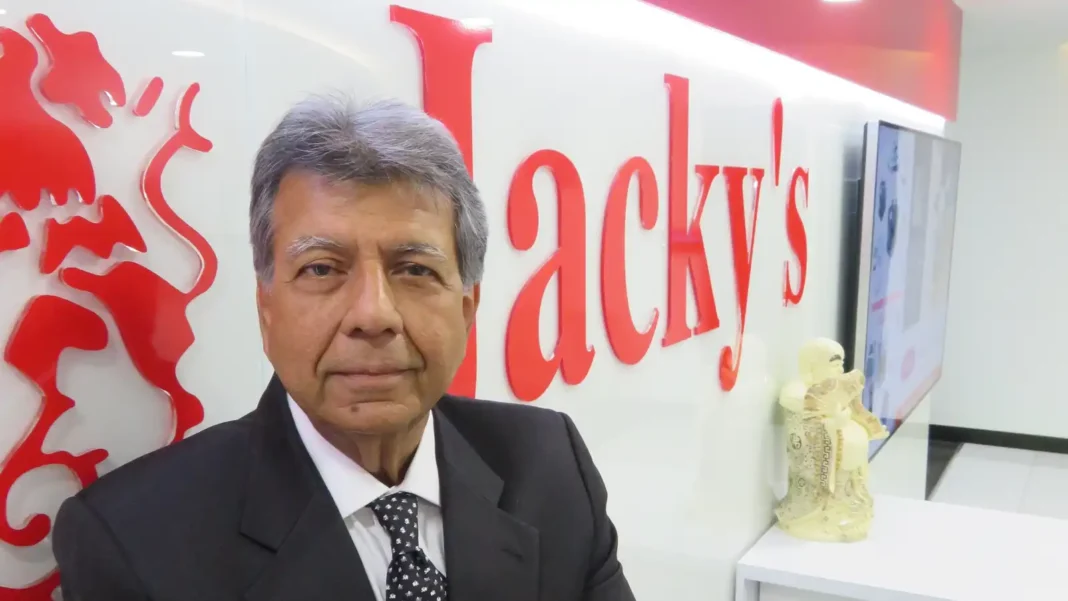
Dubai Trade Resilience has shaped Jacky Panjabi’s business strategy for more than four decades. The entrepreneur first arrived in Dubai in 1985. At the time, the region faced severe economic and geopolitical pressure. The Iran-Iraq war had already disrupted shipping across the Gulf.
Oil prices had also declined sharply during the early 1980s. Consequently, Gulf governments faced weaker revenues and reduced spending. Many businesses struggled during that period. Some residents and companies also left the UAE because of worsening economic conditions.
Panjabi, however, saw a different opportunity. He noticed that several essential household appliances cost less in Dubai than Hong Kong. Air conditioners and refrigerators stood out during his first visit. Dubai imported many products but maintained highly competitive prices. Strong competition among traders helped push prices lower. Therefore, Panjabi saw an opportunity to buy products locally and sell them elsewhere.
He purchased electronics from several suppliers during his short visit. Then, he shipped those products to other markets. The early transactions generated enough profit to encourage another move. Panjabi eventually opened a small Dubai office. The operation initially occupied a modest space in Nasser Square. The office also served as a warehouse and packing area.
The business later grew far beyond those early expectations. Dubai eventually became the company’s headquarters and an important distribution center. Panjabi had launched Jacky’s with his brother Ishwar in Hong Kong in 1970. The company originally operated as a mail-order business.
Over time, the business expanded into electronics distribution and retail. It also developed a significant wholesale and re-export operation. Dubai’s infrastructure played an important role in that expansion. The opening of Jebel Ali Free Zone created new opportunities for international traders.
The free zone connected businesses with major shipping infrastructure and global markets. It also supported companies seeking efficient re-export operations. Electronics manufacturers established regional operations in Dubai during this period. That development gave distributors easier access to major international brands.
Panjabi used that advantage to expand Jacky’s product distribution. The company supplied markets where certain electronics remained difficult to obtain. Meanwhile, Dubai continued strengthening its position as a global trading center. Its logistics network helped companies manage increasingly complex supply chains.
However, regional conflicts continued creating setbacks. During the 1991 Gulf War, Jacky’s experienced a major decline in business. Many people left Dubai during the crisis. Air travel also fell dramatically as uncertainty spread across the region. Yet the company eventually benefited from major changes in international trade. The collapse of the Soviet Union created new demand for consumer goods.
Russian and Eastern European traders began arriving in Dubai with strong demand for electronics. Jacky’s responded by hiring Russian-speaking employees.
The company also expanded its showroom operations near Dubai’s airport. Those moves helped the business capture new trading opportunities. Jacky’s later expanded into several African markets. Kenya, Tanzania, Uganda, and other countries became important destinations for its products.
Wholesale distribution increasingly became a major part of the company’s operations. Retail stores, however, helped establish Jacky’s as a familiar consumer brand. In 1996, the company built a large facility in Jebel Ali. The warehouse covered approximately 100,000 square feet. That same year, Panjabi moved his family from Hong Kong to Dubai. The company then entered another period of rapid expansion.
Jacky’s has since moved beyond traditional consumer electronics. Its business now includes robotics and advanced commercial printing equipment. The company also operates across specialized technology segments. These include industrial digital presses, 3D printers, and precision cutting systems.
Today, regional conflict has once again disrupted trade routes across the Gulf. Shipping difficulties have created fresh challenges for electronics distributors. Large electronics products generally cannot move economically by air. Therefore, distributors depend heavily on maritime transportation.
The Strait of Hormuz remains particularly important for regional shipping. Any prolonged disruption can increase costs and delay deliveries. Despite those difficulties, Panjabi remains confident in Dubai’s long-term business model. He believes companies should avoid making decisions based on short-term fear.
He advises businesses to protect cash reserves and review operating expenses carefully. At the same time, he urges companies to remain patient. Dubai Trade Resilience reflects the emirate’s ability to adapt during difficult periods. Its infrastructure and trading networks continue supporting international businesses.
Panjabi’s experience also illustrates the importance of long-term thinking. He has remained committed to Dubai through several major regional disruptions. Rather than abandoning the market during difficult periods, Jacky’s adjusted its strategy. The company repeatedly looked for new customers and trading opportunities.
Panjabi believes business leaders should avoid allowing uncertainty to dictate their decisions. Instead, he recommends focusing on costs, liquidity, and long-term demand. The current disruption presents another major test for Dubai’s trading economy. Nevertheless, the emirate retains many advantages developed over several decades.
Dubai Trade Resilience will ultimately depend on infrastructure, connectivity, and business confidence. Panjabi’s four-decade experience suggests patience can create opportunities during periods of uncertainty. For Jacky’s, the strategy remains straightforward. Preserve financial strength, manage costs carefully, and continue looking beyond immediate challenges.