



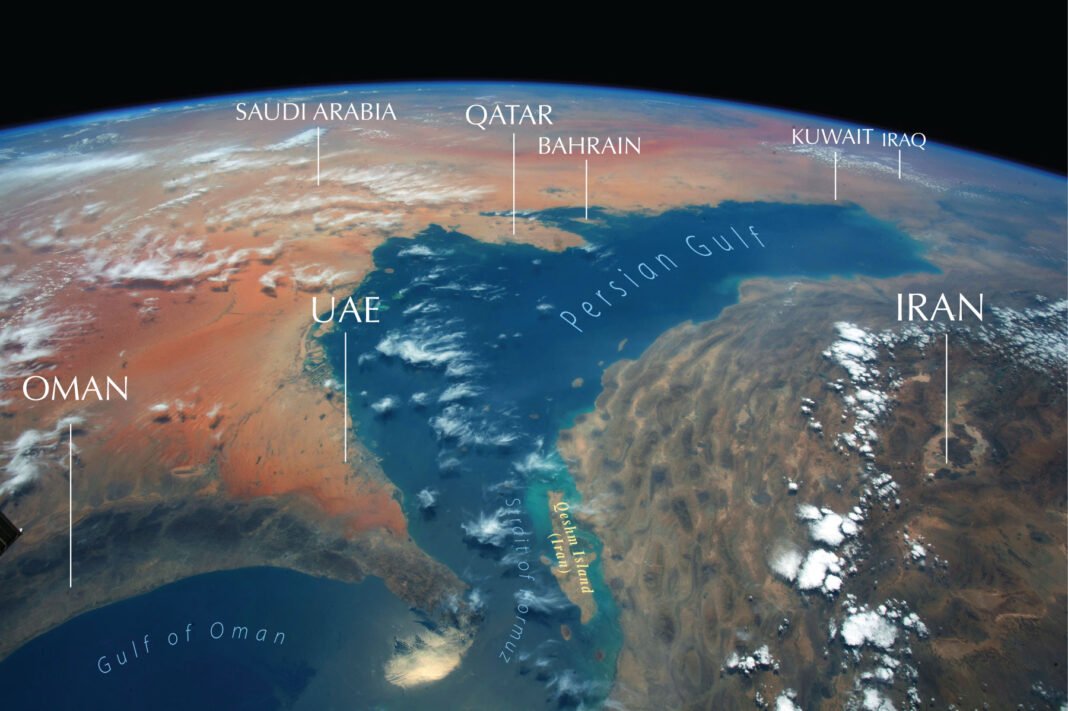
Escalating tensions between Washington and Tehran have put the Persian Gulf on high alert. In February 2026, President Donald Trump indicated a “locked and loaded” posture over Iran’s regional activities, while Tehran threatened to close the Strait of Hormuz.
For the Gulf Cooperation Council (GCC) countries, Saudi Arabia, UAE, Qatar, Kuwait, Oman, Iraq, and Bahrain, this crisis is more than political. It directly affects their economies, particularly oil exports and ambitious post-oil development projects.
The Strait of Hormuz is the world’s most critical energy artery. Nearly 20% of global seaborne oil passes through this narrow waterway. If Iran blocks or mines the channel, oil prices could spike above $120 per barrel. While higher prices benefit exporters, large-scale blockages would leave millions of barrels stranded, severely cutting revenue.
Saudi Arabia’s East-West pipeline can bypass the Strait and move up to 5 million barrels per day, but this is only half the kingdom’s production. The UAE’s Habshan-Fujairah pipeline provides an additional outlet of 1.5 million barrels per day. The remainder could remain trapped, creating massive fiscal gaps. The World Bank estimates a 5.6% budget deficit for Saudi Arabia in 2026, which could double if a conflict occurs.
Even without active combat, the economic costs are mounting. Shipping insurance premiums for tankers in the Gulf have risen from 0.3% to 0.5% of vessel value. These increases reduce the competitiveness of Gulf exports and ripple through global supply chains.
Long-term risks extend beyond oil. Economic transformation programs like Saudi Vision 2030 and UAE tech hubs rely on foreign investment and tourism. Geopolitical instability deters investors, with nearly 40% citing Middle East tension as a top-three concern. Falling U.S. markets could also weaken Gulf sovereign wealth funds, limiting funds for diversification.
Diplomatic efforts offer a potential lifeline. Turkey, Qatar, and Oman are mediating talks in Istanbul, seeking to de-escalate tensions. Gulf states must balance loyalty to the U.S. with proximity to Iran, knowing that any military escalation could target local infrastructure.
The Gulf economies risk not only temporary disruption but also long-term setbacks to modernization. High oil prices may provide short-term relief, but a conflict could undermine years of progress in trade, tourism, and investment.

