



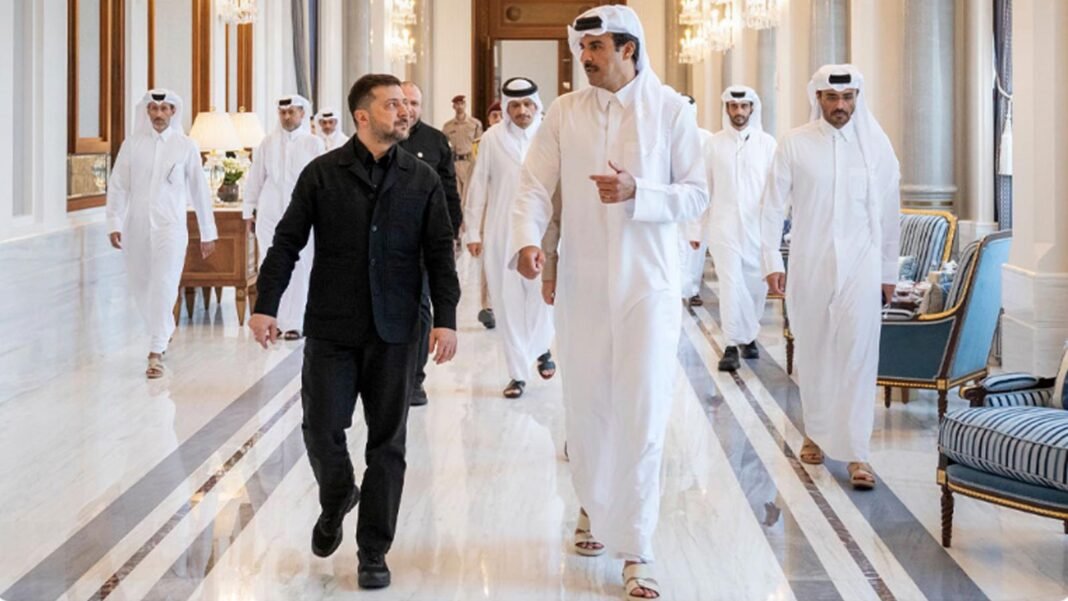
Qatar and Ukraine have signed a new defence cooperation agreement, opening the door to joint military projects, technology collaboration, and closer strategic coordination. The move signals a broader expansion of Qatar’s defence partnerships at a time of rising regional and global security pressure.
The agreement came during a high-level meeting in Doha between senior Qatari and Ukrainian defence officials. Qatar’s Deputy Prime Minister and Minister of State for Defense Affairs, Sheikh Saoud bin Abdulrahman bin Hassan Al Thani, held talks with Ukraine’s National Security and Defense Council Secretary Rustem Umerov and Armed Forces Chief of Staff Andrii Hnatov.
During the meeting, both sides reviewed current security developments and discussed ways to strengthen defence coordination. In particular, they focused on cooperation under the region’s shifting security environment and the need for stronger defence readiness.
The agreement covers several key areas. These include technological cooperation, defence investment, joint project development, and the exchange of expertise in countering missiles and drones. Therefore, the deal goes beyond diplomacy and moves into practical military and industrial collaboration.
On the Qatari side, Lieutenant General Pilot Jassim bin Mohammed Al Mannai signed the agreement. On the Ukrainian side, Andrii Hnatov signed on behalf of Ukraine’s armed forces leadership. Senior officials from both countries attended the signing in Doha.
This step matters because drone and missile threats have become a major concern for both countries, though in very different contexts. Ukraine continues to face heavy military pressure and relies on evolving defence systems. Meanwhile, Qatar has also strengthened its air defence posture after recent missile and drone threats in the Gulf.
As a result, the partnership may offer strategic value to both sides. Ukraine can gain another regional partner for technology and project cooperation. At the same time, Qatar can access battlefield-tested expertise in drone defence and modern threat response.
The timing of the deal also stands out. Qatar has expanded its diplomatic and strategic profile in recent years, especially through mediation, energy diplomacy, and defence cooperation. This latest move shows that Doha continues to widen its role in international security partnerships.
In addition, the agreement may create room for future industrial cooperation. Joint defence projects and investment clauses suggest that both countries could explore long-term collaboration in military systems, support technologies, and specialized defence solutions.
From a business and strategic perspective, defence cooperation increasingly overlaps with technology investment and national resilience. Countries now seek partnerships that combine security, innovation, and industrial capability. Consequently, this deal may carry both geopolitical and commercial implications.
The agreement may also strengthen Qatar’s defence diversification strategy. Rather than relying only on traditional Western partners, Doha appears to be building more flexible and specialized defence relationships across multiple regions.
For Ukraine, the agreement adds diplomatic and strategic depth at a time when international defence cooperation remains essential. Partnerships like this can support military adaptation, technical exchange, and future procurement opportunities.
Looking ahead, attention will likely turn to implementation. Officials may next define which joint projects move first, how investment channels develop, and whether technical cooperation expands into training or systems integration.
Qatar-Ukraine defence cooperation marks a notable step in both countries’ security agendas. It shows how defence ties now increasingly combine diplomacy, technology, and long-term strategic planning.

