



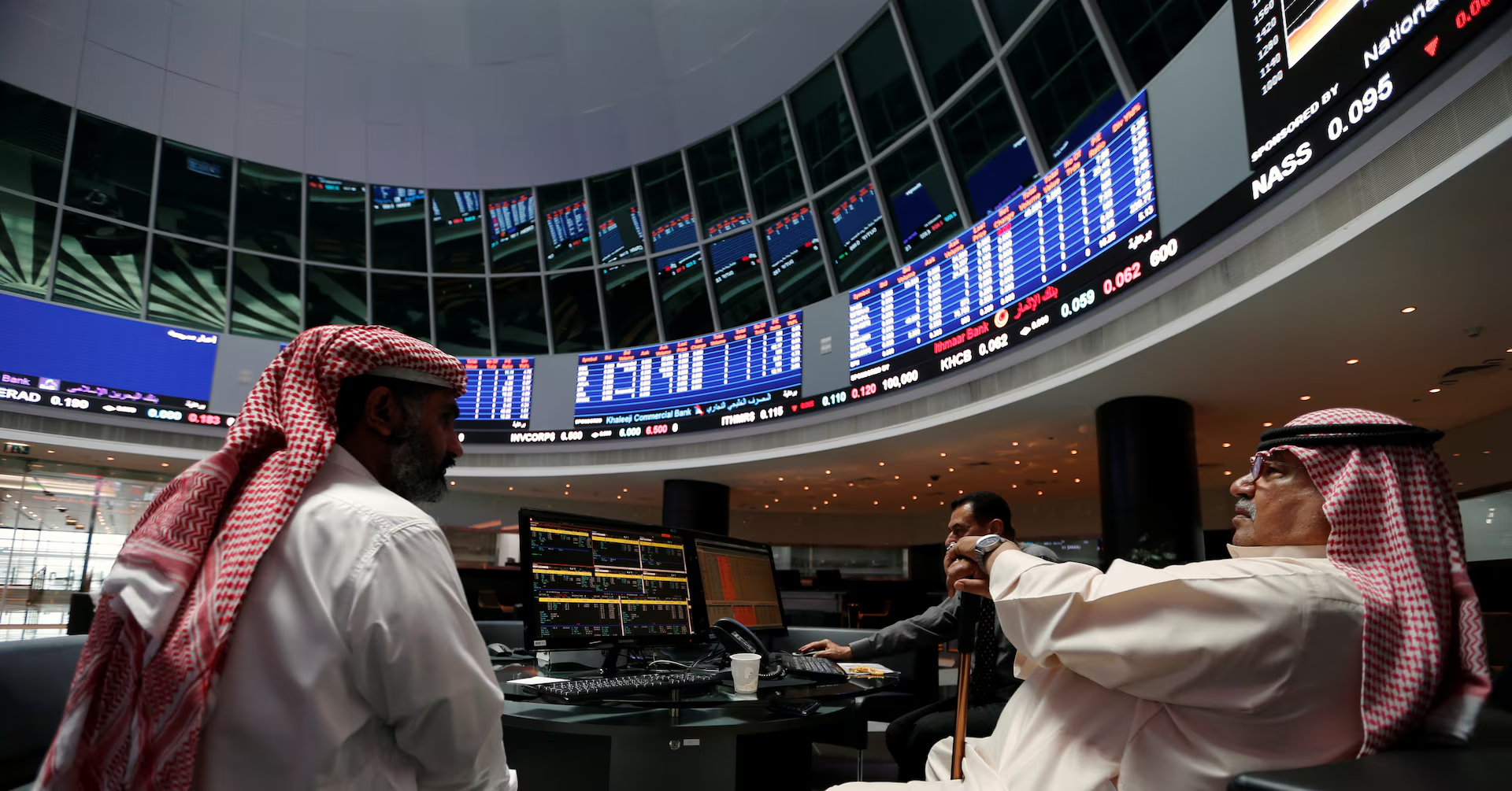
Bahrain stocks weakened in August as the All Share Index extended its decline for a second month. The benchmark ended the month at 1,936 points after losing 1 percent. The decline followed a sharper 4.2 percent drop during July. Consequently, the Bahrain market moved against most major Gulf exchanges during August.
Market performance remained broadly weak across Bahrain’s sectors. Six of the exchange’s seven sector indices recorded monthly losses. Materials suffered the steepest decline, falling 6 percent during the month. The sector ended August at 3,951 points after facing continued selling pressure. Industrials followed with a 4.4 percent decline, while consumer discretionary shares dropped 3.1 percent.
However, the financial sector provided some support for the broader market. The sector gained 0.4 percent and closed at 7,662.5 points. Gains among several major financial companies helped offset losses elsewhere. Al Salam Bank led the market’s gainers after its share price climbed 7.8 percent during August. Bahrain National Holding followed with a 2.6 percent increase, while Seef Properties gained 2.5 percent.
Al Salam Bank also attracted attention after securing a $50 million financing facility. The facility aims to expand Sharia-compliant financing for private sector businesses. Therefore, investors responded positively as the bank strengthened its financing capacity. Meanwhile, several companies recorded notable declines during the month. Aluminium Bahrain led the losers with a 6 percent drop. APM Terminals Bahrain declined 5.4 percent, while National Hotels fell 3.8 percent.
Despite the weaker index, trading activity increased significantly during August. Total share volume reached 46 million shares during the month. That figure represented a 52.3 percent increase from July’s 30.5 million shares. Trading value also climbed sharply during the period. Investors traded shares worth BD14.8 million, compared with BD9.6 million during July.
Al Salam Bank recorded the highest trading volume during August. Investors exchanged approximately 14.3 million shares in the bank. GFH Bank followed with 12.2 million shares, while National Bank of Bahrain recorded 5.4 million shares. GFH Bank also led the market by trading value, reaching BD6.6 million. Al Salam Bank followed with BD3.1 million, while National Bank of Bahrain recorded BD2.8 million.
Meanwhile, most other Gulf stock markets delivered stronger performances during August. Regional equities benefited from easing geopolitical concerns and improving corporate earnings. The wider GCC benchmark ended a three-month losing streak during the month. The MSCI GCC index advanced 3.9 percent, marking its strongest monthly gain in seven months.
Saudi Arabia recorded the strongest performance among the major Gulf markets. Its index gained 5.1 percent during August. Oman followed with a 4.5 percent increase, while Kuwait’s market rose 1.6 percent. Qatar moved in the opposite direction with a 1.1 percent monthly decline. As a result, Bahrain remained one of the weaker performers across the regional market.
Sector performance across the GCC also showed broad improvement. Hotels and leisure companies led the regional advance with a gain of nearly 10 percent. Materials shares followed with an 8.2 percent increase. Insurance stocks also performed strongly, rising 7.5 percent. Banking shares gained 4.7 percent, while telecommunications stocks advanced 5 percent. Energy shares posted a smaller 1.2 percent increase.
Global markets also ended August on a stronger footing. The MSCI World Index gained 2.6 percent during the month. However, commodity markets remained volatile because of continuing geopolitical uncertainty. Oil prices moved sharply throughout August as investors monitored developments across the region.
Brent crude initially fell below $80 per barrel as peace discussions supported expectations of improved supply conditions. However, prices later recovered above $90 per barrel as fresh attacks increased uncertainty. These movements continued to influence investor sentiment across regional markets.
For Bahrain stocks, August therefore presented a mixed picture. The benchmark declined even as trading volumes and values increased substantially. Stronger activity suggests investors remained engaged despite broader market weakness. However, losses across most sectors continued to weigh on the headline index.
Going forward, investors will likely monitor corporate earnings, regional developments and oil prices closely. Market conditions could remain sensitive to changes in geopolitical risks. At the same time, stronger activity in financial shares could provide some support. Bahrain stocks may therefore remain focused on sector performance as investors assess the next direction.

