



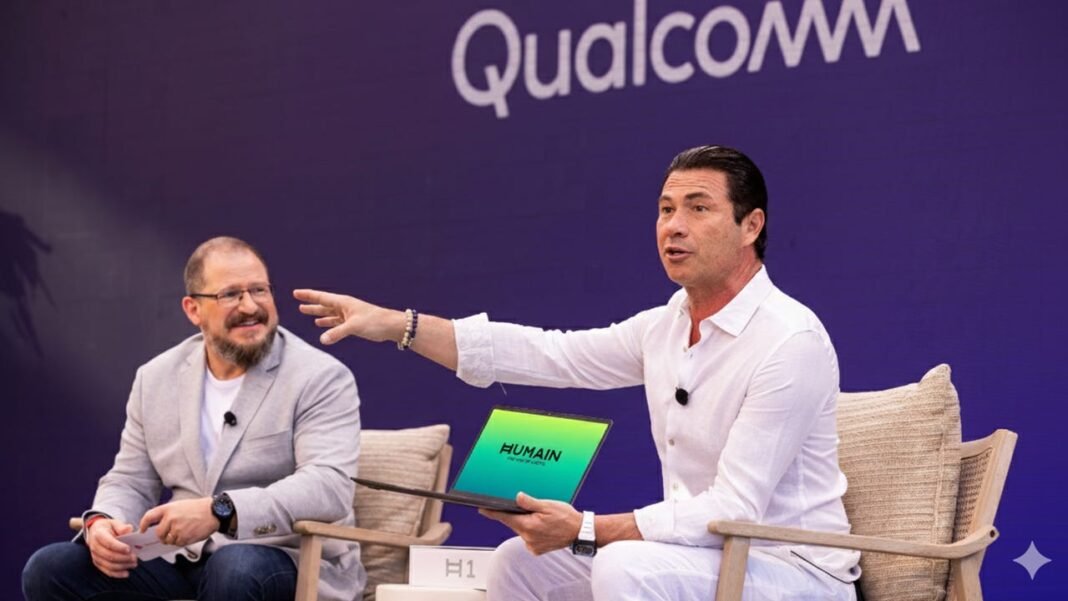
Humain AI Laptop technology is taking shape as Saudi Arabia expands its ambitions in artificial intelligence and advanced computing. Saudi AI company Humain and Qualcomm have introduced a new AI-focused laptop in Riyadh. The companies say the device could change how people interact with personal computers. The new computer uses an agent-based artificial intelligence system designed around user intentions. Instead of opening separate applications, users can describe the result they want. AI agents can then coordinate several tasks to complete that request.
The approach could simplify activities such as arranging travel and preparing presentations. It could also support financial tasks and other routine professional work. Furthermore, the system can learn user preferences and adapt its responses over time. Qualcomm developed the laptop around its Snapdragon X2 Elite computing platform. The processor can deliver up to 80 trillion AI operations every second. The device can also provide up to 22 hours of battery life.
Humain has worked with Qualcomm for more than a year on the new computer. Engineers from both companies contributed to hardware, software, and industrial design. The collaboration also reflects Saudi Arabia’s broader effort to develop local technology capabilities. The laptop initially will run on Windows. However, Humain plans to introduce its own operating system during 2027. The companies also expect the device to eventually reach individual consumers.
Enterprise customers can access the computer from September 20. However, the companies have not yet announced consumer pricing or availability. That information will likely emerge as development and commercial plans progress. Humain operates under Saudi Arabia’s Public Investment Fund. The company has become an important part of the kingdom’s strategy for expanding artificial intelligence infrastructure. Its activities now extend across computing, data centres, software, and related technology.
The latest laptop represents another step toward bringing AI directly onto personal devices. Traditional systems often send demanding AI tasks to remote data centres. On-device processing can instead handle some workloads directly on the computer. This approach can reduce dependence on constant cloud connectivity for certain tasks. It may also improve response times and provide greater control over sensitive information. However, larger workloads can still require powerful remote computing infrastructure.
Qualcomm has increasingly focused on this combination of local and cloud computing. The company describes the approach as hybrid AI. Under this model, devices and data centres share computing responsibilities. The system can determine where each AI task should receive processing. Smaller workloads can remain on smartphones, computers, vehicles, and other devices. More demanding operations can move to larger data centre systems.
Humain and Qualcomm are also cooperating on Saudi Arabia’s AI infrastructure. Their work includes data centre technology and local engineering capabilities. The partnership therefore extends well beyond the newly introduced laptop. The companies are developing AI infrastructure within Saudi Arabia. Adobe has also prepared to move regional AI workloads onto Humain’s Saudi-based infrastructure. This arrangement would keep associated data and computing inside the kingdom.
Qualcomm has also expanded its engineering presence in Saudi Arabia. Its operation in Riyadh brings together international and Saudi engineering talent. The teams work on technologies supporting artificial intelligence and advanced computing. The partnership also involves Saudi Aramco and its digital transformation efforts. Qualcomm is applying technology developed for smartphones across multiple industries. These areas include vehicles, industrial systems, personal computers, and AI infrastructure.
The expansion reflects a broader shift within the technology industry. Artificial intelligence increasingly requires computing power across many types of devices. As a result, chipmakers are developing platforms for both local and remote processing. Humain AI Laptop development also supports Saudi Arabia’s goal of building domestic technology expertise. Local engineers are gaining experience through direct cooperation with global technology specialists. This could help strengthen the kingdom’s long-term digital capabilities.
The project also demonstrates how Saudi companies are entering advanced technology markets. Rather than relying entirely on imported systems, local companies are developing products with international partners. Consequently, these collaborations could support broader technology investment within the country. For businesses, the new laptop could provide a more integrated way to use artificial intelligence. Users may complete several connected tasks through a single instruction. That model could reduce the need to switch repeatedly between different software applications.
Battery performance will also remain important for professional users. The reported 22-hour battery capacity could support extended working periods. However, real-world performance will depend on workload, settings, and usage patterns. Security and data management could also influence enterprise adoption. Local AI processing may offer advantages for certain sensitive workloads. Meanwhile, cloud systems can provide additional computing power for complex operations.
Humain AI Laptop development therefore forms part of a much larger technology strategy. Saudi Arabia continues investing heavily in artificial intelligence and digital infrastructure. The latest partnership adds personal computing to that expanding technology ecosystem. The companies now face the challenge of turning the technology into a widely adopted product. Enterprise customers will provide an early test of its capabilities. Consumer expansion could follow once Humain establishes the product’s market position.
Overall, the collaboration strengthens technological ties between Saudi Arabia and Qualcomm. It combines local AI ambitions with advanced semiconductor and computing expertise. The partnership could also accelerate the development of AI-focused products within the kingdom. At the same time, the project highlights Saudi Arabia’s growing role in regional artificial intelligence development.

