



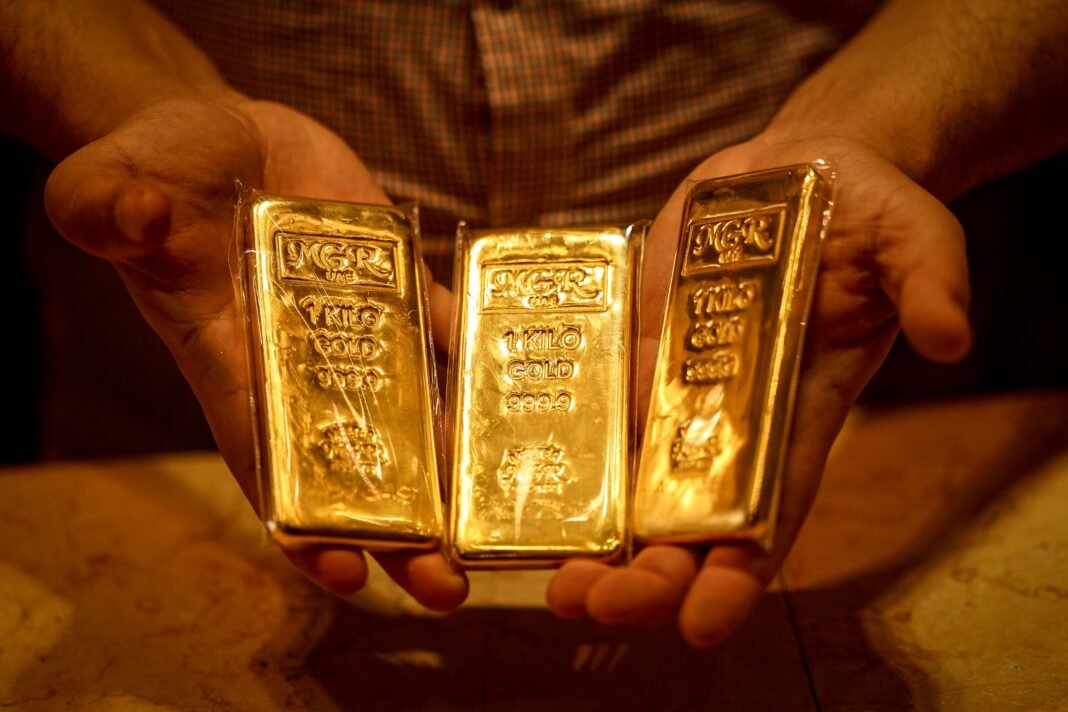
Dubai gold prices eased on Wednesday as renewed inflation concerns weighed on precious metals. Rising oil prices also added pressure to the market. The 24-karat gold rate reached Dh523.50 per gram at the market opening. That marked a decline from Dh526 per gram at Tuesday’s close.
Meanwhile, 22-karat gold traded at Dh484.75 per gram. The 21-karat rate stood at Dh464.75 per gram. The 18-karat category reached Dh398.50 per gram. The 14-karat rate stood at Dh310.75 per gram. The movements reflected growing caution among traders as markets assessed inflation risks and energy prices.
Global precious metals also showed mixed movements during early trading. Spot gold traded around $4,334 per ounce. The metal gained about 0.11 percent during the session. Silver also moved higher during early trading. Spot silver traded near $66.66 per ounce. It gained about 0.95 percent during the same period.
However, the gains remained limited as investors considered several competing economic factors. Inflation remains a major concern for financial markets. Higher energy costs could increase price pressures across several major economies. That possibility could influence future decisions from central banks.
Oil markets also attracted renewed buying interest after several weaker sessions. Higher oil prices can create additional inflationary pressure across economies. Therefore, investors are closely monitoring developments in energy markets. Stronger inflation could encourage central banks to maintain restrictive monetary policies. Such policies can limit demand for gold and other precious metals. Gold often faces pressure when interest rates and bond yields rise.
However, gold can also attract demand during periods of geopolitical uncertainty. Investors therefore continue balancing economic risks against regional tensions.
Regional developments remain another important factor for precious metal markets. Continued tensions in the Middle East have increased uncertainty among investors. Political developments could quickly change market sentiment and commodity prices. At the same time, diplomatic discussions have created some expectations for reduced tensions. Investors are watching those developm
ents for clearer signs of possible de-escalation. Any improvement could reduce demand for traditional safe-haven assets. However, renewed tensions could produce the opposite effect. A significant escalation could also push oil prices higher. That outcome could further complicate the inflation outlook.
The US dollar is another factor influencing gold’s recent performance. The currency has remained relatively firm against several major currencies. A stronger dollar can make gold more expensive for international buyers. C
onsequently, stronger dollar demand can limit gains in the precious metal. Investors are also monitoring upcoming discussions between major global powers. Any major announcements could influence currencies, commodities, and broader financial markets. Traders may therefore remain cautious until they receive clearer signals.
Technical indicators also point toward weaker short-term momentum for gold. The daily Relative Strength Index has moved below the 50 level. That development suggests that buying momentum has weakened recently. However, technical indicators do not guarantee future price movements. Analysts are watching the $4,261 level as a potential support area.
The level sits near an upward trendline connecting previous market lows. A sustained decline below that area could increase selling pressure. Conversely, stronger buying could help gold recover toward recent highs.
Silver faces a similar technical structure in the current market. Traders are monitoring the $63.36 area as potential support. That level reflects lows recorded during August and September. A move below that point could attract additional selling interest. However, renewed demand could help silver stabilize above the support area. Market participants will continue watching price movements alongside broader economic developments.
Dubai gold prices therefore remain influenced by several competing forces. Inflation, oil prices, interest rates, currency movements, and geopolitical tensions all remain important. For consumers, daily price changes can affect jewelry purchases and investment decisions. Buyers may continue monitoring rates before making larger purchases.
Traders will also focus on upcoming economic data and central bank signals. Meanwhile, developments in the Middle East could create sudden market movements. If oil prices rise sharply, inflation concerns could intensify further. If tensions ease, pressure on safe-haven demand could increase.
For now, gold appears to remain within a relatively narrow trading range. Investors are waiting for stronger signals before making major moves. Dubai gold prices could remain under pressure if inflation concerns persist. However, geopolitical developments could quickly alter market sentiment. Oil prices will also remain an important factor for precious metals. Traders will therefore continue watching economic data, central bank policy, and regional developments closely. The next major market moves could depend on how these factors develop together.

